Sunlit learning tabletop with books, open practice notebooks, contextual learning tiles and planning board.
Books: People, Process, Technology, Outcomes. Tiles: Explore, Practice, Reflect, Apply. Notebook: Understand; Explore, Analyse, Apply; Key considerations. From insight to action; People, Process, Technology; Consider real work context; Build in application. Review and refine; Real-world application. Board: Current state, Options, Build, Implement; People, Process, Technology, Risk & compliance. These are illustrative contextual learning relationships.

Capability

Learning & capability development.

Practical learning, coaching and workplace application — building skills around the work people need to do.

A useful programme connects participant needs, relevant practice, feedback and the support needed to apply a skill in everyday work.

Programme & credential clarity

Lean and Six Sigma learning

Practise improvement on work that matters.

Build practical skills in process improvement, problem solving and data-led decisions through relevant exercises and application.

Start a conversation
Illustrative order-to-dispatch practice exercise with process steps, evidence questions and reflection notebook.
Illustrative practice exercise. How can we reduce the time from order to dispatch? Receive order → Check stock → Pick items → Pack order → Dispatch. Where does work wait? Waiting for stock check? What evidence would help? Cycle times? Queue length? Rework? Handovers? What would you review? Process steps, Data and assumptions, Root causes, Next experiment. Process map. Data and observations; Variation in pick times; Batching creates delay; Information not always clear. Apply and reflect: What did we learn? What would we try next? How could this apply to our work? Books: Define, Measure, Analyse, Improve, Control. Illustrative charts and observations are exercise material, not client evidence or results.
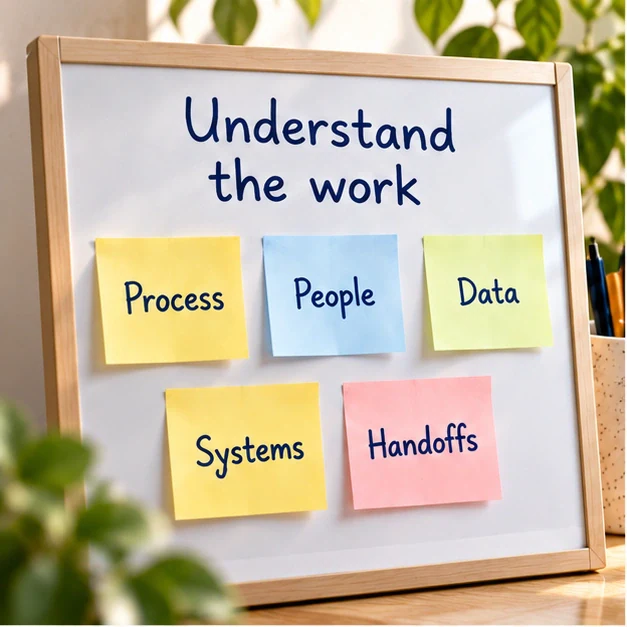
A practice board groups process, people, data, systems and handoffs around understanding the work.
Understand the work: Process, People, Data, Systems, Handoffs.

Process understanding

Connect an operating problem to the work and evidence that need examination.

Magnifying glass over an illustrative chart, with prompts to seek patterns, test causes and confirm evidence.
Analyse. Look for patterns; Test possible causes; Confirm with evidence. A sample chart is illustrative, not a reported result.

Problem solving

Use relevant exercises to practise a structured response to a specific question.
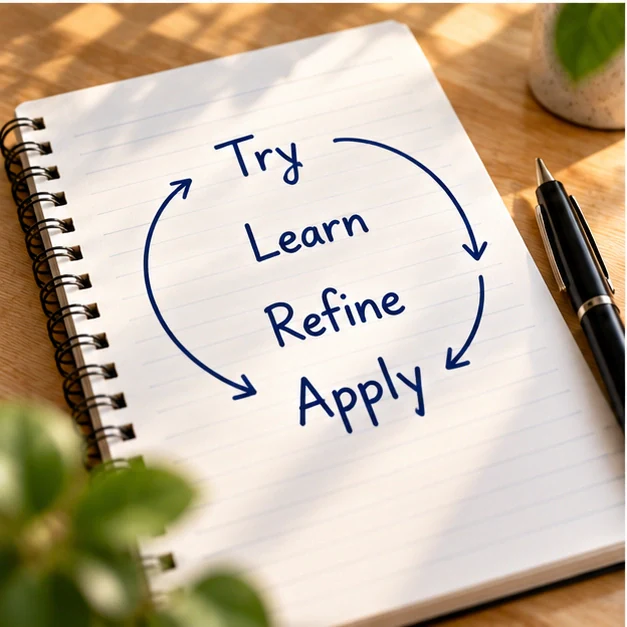
Notebook shows a recurring feedback loop between trying, learning, refining and applying.
Try, Learn, Refine, Apply, connected by a feedback loop.

Applied learning

Connect the method to participant work, practice and feedback.

Learning is more useful when participants can practise the method on a relevant problem and review how they used it.

Agile learning & programme pathways

Build the practices behind delivery and collaboration.

Develop delivery, prioritisation, collaboration and flow practices through learning suited to participant roles and work.

Illustrative Agile learning board connects context, priorities, handoffs, feedback and workplace application.
Understand — Explore and align: Context, Roles, Work examples. Practise — Apply together: Priorities, Handoffs, Feedback. Apply — Take to your work: Ideas to action, Real work scenarios, Next steps. Books: Agile mindset, Team collaboration, Delivery and flow, Practical application. Practice exercise: People, Process, Work. Priorities: Clarify the need, Consider options, Agree next steps, Plan and iterate. Learn, Practise, Apply. Arrows relate example activities, not a mandatory programme sequence.

Delivery and priorities

Practise how work is chosen, organised and reviewed.

Collaboration and flow

Examine handoffs, shared understanding and the movement of work.

Workplace application

Connect exercises, feedback or coaching to situations participants need to handle.

SAFe-branded programmes and credentials depend on confirmed provider authorisation and programme scope.

Programme and credential clarity

Compliance and contractor programmes

Make workforce responsibilities understandable in practice.

Build understanding of labour-law, Provident Fund (PF), Employees’ State Insurance (ESIC), contractor and site-compliance responsibilities with appropriately reviewed subject content.

Responsibility-learning books, hard hat, example plans and unchecked practice questions about records and handoffs.
Labour-law; PF and ESIC; Contractor management; Site compliance. Illustrative example for learning purposes only. Illustrative practice: Records, Handoffs, Site responsibilities, Questions for review. People, Process, Practice, Progress. Empty checkboxes do not certify compliance.
Labour-law, PF, ESIC, contractor and site-compliance learning books beside a neutral responsibility checklist.
Labour-law, PF, ESIC, Contractors, Site compliance. Key responsibilities; neutral empty checkboxes.

Relevant responsibilities

Connect learning to the workforce or site duties participants need to understand.

Illustrative workforce records and unchecked review questions; no real participant or client records.
Illustrative records for practice: Attendance register, Wage payment record, PF contribution statement, ESIC return, Contractor documents. What to check? What is missing? Who receives this? Any follow up? Empty checkboxes; no real records or personal data.

Practical situations

Use relevant examples and exercises to examine records, handoffs and questions needing attention.

Notebook connects guidance, worked examples, discussion points and operating instructions to practical learning.
From understanding to application: Guidance, Worked examples, Discussion points, Operating instructions. Learn, Practise, Apply.

Continuing practice

Support client and contractor teams with reviewed guidance, feedback or operating instructions suited to scope.

Learning supports understanding and application. It does not by itself establish compliance or transfer management accountability.

Illustrative work examples and records are for learning purposes only; they do not contain actual participant or client data.

Data analysis, ISO learning & professional pathways

Develop understanding you can apply to evidence and standards.

Develop applied data-analysis skills and understanding of relevant ISO standards. Any professional certification pathway requires confirmed programme and awarding arrangements.

Laptop displays illustrative data-analysis exercise charts and exploratory prompts beside analytical-learning books.
Illustrative exercise. Explore, Compare, Consider, Draw insights. Books: Data, Analysis, Decisions. Chart is illustrative exercise material, not measured performance.

Data analysis

Practise examining information and interpreting it in the context of a work question.

Standards-learning books and pending learning-objective circles cover concepts, context, roles and application.
Understand the standard; Operating responsibilities; Applying in practice; Discussion and scenarios. Learning objectives: Key concepts, Business context, Roles and responsibilities, Applying the requirements. From understanding to application. Neutral empty circles; no certification authority implied.

ISO learning

Build understanding of relevant standards and their relationship to operating responsibilities.

Stone programme, assessment and awarding blocks beside a pending confirmation panel; no credential offer is confirmed.
Programme arrangements, Assessment arrangements, Awarding arrangements. Confirm before offering: Programme, Assessment, Awarding, all pending empty circles. All three arrangements require confirmation before any credential-bearing offer; the stone arrangement is not a guaranteed programme sequence.

Professional pathways

Clarify the programme, assessment and awarding arrangements before presenting a credential-bearing option.

Understanding a standard and being authorised to certify against it are different things.

Programme and credential clarity

Learning & capability development

Connect learning to the work that follows.

Learning can combine subject input, coaching and workplace practice. Participants and managers need a way to review evidence of use and continuing support.

Four connected learning-support installations show need, practice, application review and ongoing workplace support.
Need: Role context and capability gap. Practice: Relevant exercises. Apply and review: Evidence of use and open questions; What worked? What is next? Where is more support needed? Ongoing support: Manager support and workplace enablers. Books: Instructions, Standards, Coaching, Review. Two-way connectors describe contextual relationships, not compulsory programme stages.
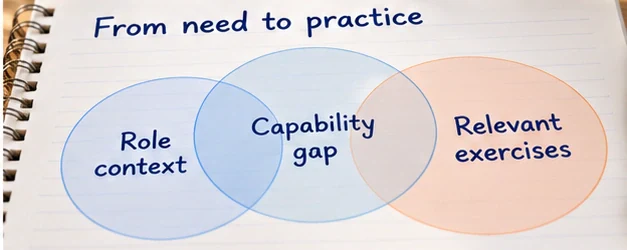
Overlapping notebook circles relate role context, capability gap and relevant exercises.
From need to practice: overlapping Role context, Capability gap, Relevant exercises.
01

Participant need and practice

Connect role-based objectives and relevant exercises to the capability gap.

Unchecked practice-review questions and a note ask what worked, what could improve and what support is needed.
Application in practice: Used in work, Adapted approach, Questions raised, Further support needed, empty checkboxes. What worked? What could be better? What support next?
02

Feedback and evidence of use

Review application, questions and remaining gaps with appropriate coaching or feedback.
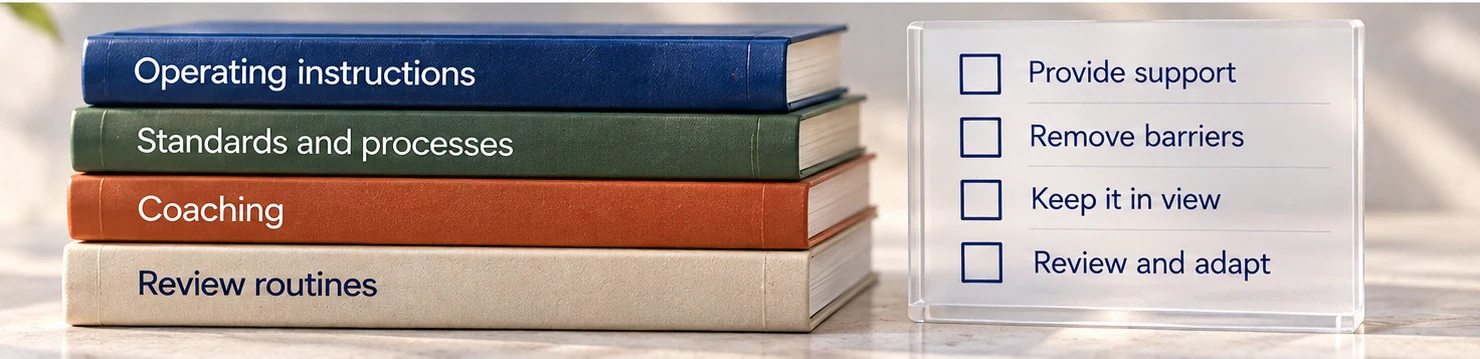
Learning-support books and unchecked prompts cover support, barriers, continued review and adaptation.
Operating instructions, Standards, Coaching, Review routines. Provide support, Remove barriers, Keep it in view, Review and adapt; empty checkboxes.
03

Support in the workplace

Consider manager support, internal coaching, standards, operating instructions, ownership and review routines relevant to the work.

Evidence of practical use and remaining support needs can inform continuing development.

These are contextual possibilities, not compulsory programme stages.

Programme and credential clarity

A learning objective and a credential are different questions.

Practical capability concerns what a participant can understand and apply. A credential depends on confirmed programme, assessment and awarding arrangements.

Two installations distinguish practical capability from a credential question requiring confirmed arrangements.
Build practical capability: Understand, Apply, Practise. A separate credential question: Confirm programme, Clarify assessment, Establish awarding arrangements, No promise of award.
Illustrative content, learning and application books; provider authorisation remains a separate confirmation.
Content, Learning, Application. Illustrative programme materials do not confirm provider authorisation.

Programme and provider

Confirm the proposed programme, availability and responsible provider’s authorisation.

Assessment clipboard with three empty boxes, indicating requirements still need clarification.
Three empty assessment checkboxes and neutral placeholder rules. No completed assessment is shown.

Assessment

Clarify requirements and the applicable assessment arrangements.

Stone blocks marked awarding, basis and arrangements illustrate conditions that need confirmation.
Awarding, Basis, Arrangements. Conceptual blocks do not promise an award.

Awarding arrangements

Establish who awards the credential and the basis on which it may be offered.

No authorised programme or professional award is promised before those arrangements are confirmed. ISO learning does not establish ISO certification authority.

SAFe and professional pathways depend on confirmed arrangements.

Discuss your question

Let’s talk

Start with the capability your work needs.

Share who needs to learn, the subject you have in mind and where the learning would be applied. Explore the programme scope, practical support and any credential arrangements that need clarification.

Start a conversation
Three glass panels ask who needs to learn, the subject, and where learning will be applied.
Participants: Who needs to learn? Subject: What is the learning focus? Application: Where will it be applied? Books: People, Practice, Progress. Notebook overlapping People, Practice, Application circles.