Coastal operating landscape linking a container port, logistics warehouse, construction project and processing facility through a blue route.

Capability

Operations, procurement &
project delivery.

Practical support for sourcing, supplier commitments, programme control and operational readiness — connecting the decisions that shape delivery.

Requirements, suppliers, resources and approvals affect the same delivery commitment. Physical completion and operational acceptance need different evidence.

Procurement and tendering

Make the supplier
decision clear.

Clarify requirements and evaluation criteria, support tendering and negotiation, and organise commercial documentation for supplier decisions.

Documents and stone plinths connect requirements, tender comparison and recommended terms to a blue and brass client approval ring.
Requirements; Tendering and evaluation; Negotiation and documentation; Client approval. Requirements document: Functional requirements, Technical specification, Scope and standards, Evaluation criteria. Tender responses; Supplier B; Supplier C. Commercial comparison: Price and commercial terms, Delivery and programme, Technical capability, Risk and compliance, Support and service; A, B, C. Recommended option: Evaluation summary, Commercial terms, Key commitments, Trade-offs and considerations. Comparison dots are schematic, not supplier results.
01

Requirements

Define the scope and technical needs against which proposals will be considered.

Technical requirements drawing with scope, standards, interfaces and delivery document stacks.
Performance requirements; Standards and compliance; Interfaces and dependencies; Scope of supply; Evaluation criteria. Scope; Standards; Interfaces; Delivery.
02

Tendering and evaluation

Make comparison criteria and the basis of the recommendation understandable.
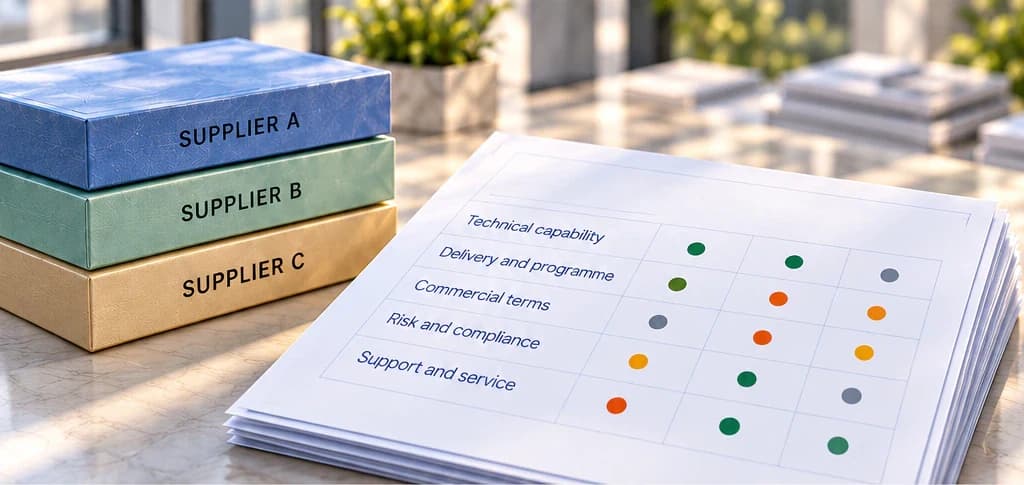
Three supplier document stacks beside a schematic evaluation matrix.
Supplier A; Supplier B; Supplier C. Technical capability; Delivery and programme; Commercial terms; Risk and compliance; Support and service. Schematic comparison dots only.
03

Negotiation and documentation

Connect proposed terms, commitments and approval needs to the supplier decision.

Commercial terms papers beside draft, negotiation, final terms and approval document stacks.
Pricing and payment terms; Contract conditions; Milestones and deliverables; Risk allocation; Approvals and next steps. Draft; Negotiation; Final terms; Approval.

Requirements shape the tender; evaluation and commercial terms inform the decision.

The client retains the approval of trade-offs and supplier selection.

Relevant information may include requirements, sourcing criteria, tender records and commercial documentation.

Vendor performance & supply resilience

See what supplier
performance means
for supply.

Review supplier performance, forecasting, logistics and inventory exposure to identify actions requiring attention.

Start a conversation
A blue route and four callouts connect supplier containers, truck logistics, warehouse inventory and operating needs.
Suppliers; Logistics; Inventory; Your operations. Blue nodes connect the supplier port to movement, stock and operating needs.

Supplier commitments and performance

Examine the difference between agreed expectations and observed delivery.

Cardboard packages moving along a roller conveyor.
Packages on conveyor; incidental handling symbols are illustrative.

Forecasting and lead times

Consider how changing demand or timing affects supply decisions.

Laptop displaying schematic overlapping blue and orange forecasting waves.
Schematic blue and orange forecasting waves, no numeric data.

Logistics and inventory

Connect movement and stock exposure to the operating requirement.

Complete cardboard boxes on a pallet in the centre of an orange-and-blue warehouse aisle, without people.
Complete cardboard boxes on a central wooden pallet in a warehouse aisle. An unoccupied pallet jack stands behind the pallet. Incidental package markings are decorative.

A supplier concern can affect schedules and inventory.
Review the exposure and the action or decision it requires.

Useful information may include

  • Supplier records
  • Lead times
  • Forecasts
  • Inventory information
  • Supplier reviews or scorecards

Project controls & budgetary control

Connect progress to the
decisions that govern delivery.

Bring resources, milestones, approvals, budgets and actions into a usable programme control process.


Four linked stone plinths hold a schedule, construction resources, budget columns and approval checklist; progress evidence points towards enabling decisions.
Schedules; Resources; Budgets; Approvals. Progress evidence → Decisions that enable what’s next.
Elevated concrete bridge under construction across a mountain valley.
01

Milestones and resources

Understand timing, dependencies and the resources needed for the commitment.

Brass and silver sculptural bars illustrating budget allocation.
02

Budgets and utilisation

Make allocation, use and outstanding release or correction decisions visible.

Organised records with approval, review and action tabs.
Approval; Review; Action.
03

Approvals and open actions

Connect unresolved questions to accountable decision owners.

A milestone report is more useful when it shows the resource, budget and approval questions affecting what can happen next.

Useful information may include

  • Schedules
  • Resource information
  • Budget reporting
  • Action and approval records

Defined roles

Support organises relevant evidence and controls.

Client owners approve trade-offs.

Green-field setup & commissioning

Installation is one milestone.
Operating readiness
is another.

Support green-field and R&D layout and construction planning, installation readiness, commissioning, SOPs and operating handover within an agreed delivery role.


Cutaway R&D facility shows process vessels, pipes and an empty receiving-operation control area.
Hardhat, plans, tablet and miniature research facility layout on a desk.

Setup planning

Layout and construction planning must connect to the intended operation or R&D use.

Illustrative commissioning checklist on a tablet inside a stainless process installation.
Commissioning readiness; Systems installation; Agreed acceptance criteria; Commissioning evidence; Ready for handover. Illustrative checklist, not verified facility status.

Installation and commissioning

Examine readiness, agreed acceptance criteria and commissioning evidence with the responsible technical contributors.

Empty control room overlooking stainless process equipment.
Illustrative control-room screens are decorative, not a functioning product.

Operating handover

Connect documentation, standard operating procedures, practical training and receiving-operation ownership.

Physical completion does not by itself establish acceptance by the operating team.
Criteria, commissioning evidence and usable operating information support that decision.

Setup, commissioning and handover support are scoped to an agreed role. Technical contributors and the client retain their respective approvals and acceptance responsibilities.

Start a conversation

Relevant information may include layouts, installation status, commissioning plans, SOPs, training and handover records.

Connected delivery decisions

A changed commitment
can
affect more than
one decision.

Requirements, supplier commitments, resources, budgets and acceptance evidence should remain connected to the decisions they inform.

Four miniature islands for requirements, suppliers, resources and budgets, and operational acceptance connect through coloured arcs to a transparent hub.
Requirements; Suppliers; Resources & budgets; Operational acceptance. Blue and orange arcs connect these four areas to a central transparent hub. Relationships are conditional, not a universal delivery model.

Requirement changes

A requirement change may alter sourcing criteria, commercial terms and approval needs.

Supplier commitments

Supplier timing or performance may affect logistics, inventory and programme milestones.

Resources & budgets

Resource or budget changes may affect release decisions and readiness.

Operational acceptance

Installation status, commissioning evidence and receiving ownership inform operational acceptance.

Support brings the relevant information into view.

Technical and commercial contributors remain responsible for their inputs;

client owners approve trade-offs and acceptance.

Let’s talk

Bring your delivery question into focus.

Share the sourcing, supplier, programme or setup question you face. Explore the support, evidence and responsibilities relevant to its current stage.

Start a conversation
Independent illustrative delivery contexts: warehouse and suppliers, programme calendar, setup readiness and operating handover, on separate limestone plinths.
Four independent illustrative contexts: Sourcing and suppliers; Programme and schedule; Setup and readiness; Delivery and handover. These are optional service entry points according to the question and agreed responsibilities, not compulsory engagement stages.

Illustrative delivery contexts. Each service can be considered separately, according to your question and agreed responsibilities.