Sunlit financial desk with labelled service papers, laptop, report and a notebook connecting options, implications and next steps.
Laptop: Valuation; Transactions; Tax; Financial reporting; Budgetary control. Tabs: DUE DILIGENCE; TAX; FINANCIAL REPORTING; BUDGETS; TRANSACTIONS; VALUATION. Notebook: Options → Implications → Next steps. Report: FINANCIAL REPORT.

Finance, transactions & tax

Examine value, transaction choices and tax questions alongside financial reporting and budgetary control.

Discuss your financial question

Financial advisory

Financial advisory
and valuation

Examine business value, financial structure, budgets and forecasts, documenting the assumptions behind the decision.

Accounts, business model and operating evidence feed explicit assumptions, then analysis of value, exposure and decision criteria.
Accounts: Financial statements, reconciliations and balance sheet detail. Business model: Revenue model, cost structure and value drivers. Operating evidence: Forecasts, assets and volumes. These three inputs feed Assumptions: Material assumptions and missing evidence remain visible. Analysis: Documents value, exposure and decision criteria. Value: How value is derived. Exposure: Key sensitivities and risks. Decision criteria: The basis for consideration.

Value depends on multiple perspectives

Business value depends on accounts, the business model and operating evidence.

Evidence and assumptions are visible

Includes forecasts, reconciliations, assets and volumes, with material assumptions and missing evidence highlighted.

Analysis for the decision

Documents value, exposure and decision criteria.

Formal valuation requires an agreed scope

Formal valuation requires an agreed scope and an appropriately appointed professional provider.

Clients retain decision authority

Clients confirm assumptions and retain decision and approval authority.

Transactions and restructuring

Transactions and restructuring

Connect due diligence, transaction options, capital or business restructuring, and financial, commercial, tax and implementation consequences.

Agreements, counterparties and diligence evidence inform transaction options, considered alongside financial, commercial, tax and implementation consequences.
Inputs: Agreements — Terms and obligations; Counterparties — Parties and obligations; Diligence evidence — Findings and gaps. Identify gaps and key issues. Transaction and restructuring options — Evaluate and shape the possible paths. Assess consequences together. Key considerations: Financial — Value, funding and balance sheet impact; Commercial — Market, customers and contracts; Tax — Structure and jurisdictional implications; Implementation — Practicality, timing and readiness. An informed decision — Options for sponsors and approvers.

Agreements, counterparties, evidence gaps and diligence working papers inform options for sponsors and approvers. Diligence informs a decision, not a guaranteed outcome. Formal professional deliverables have separately agreed scope and responsibility.

Discuss transactions and restructuring

Taxation perspective

Direct and indirect taxation

Consider tax questions in the context of the entity, jurisdiction and activity, with the responsible professional provider.

Discuss a tax question
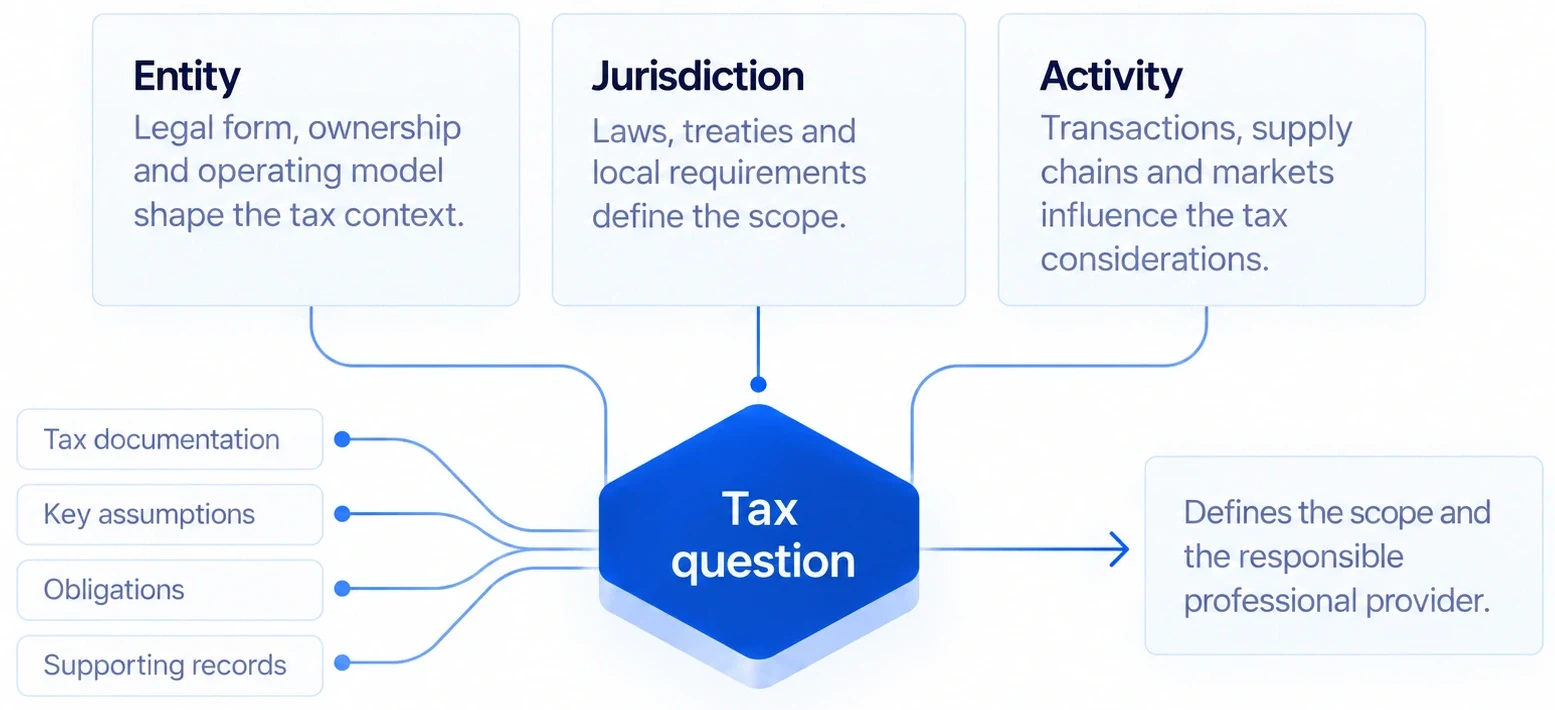
Entity, jurisdiction, activity and supporting tax evidence inform a tax question and its professional scope and responsibility.
Entity: Legal form, ownership and operating model shape the tax context. Jurisdiction: Laws, treaties and local requirements define the scope. Activity: Transactions, supply chains and markets influence the tax considerations. Tax documentation; Key assumptions; Obligations; Supporting records. These context and evidence inputs converge on Tax question, which defines the scope and the responsible professional provider.

Direct tax

Consider how the entity, activity and jurisdiction affect income, capital and other direct tax considerations.

Goods and services tax (GST)

Consider how your supplies, customers, locations and transactions affect GST obligations.

Transfer pricing

Consider how intercompany arrangements, value creation and jurisdictional requirements affect transfer pricing.

International tax

Consider cross-border activities, treaties and jurisdictional rules relevant to your tax question.

Import-export questions

Consider how cross-border movement of goods and services affects your tax obligations.

Financial management

Reporting and
budgetary control

Review accounting and management information, cash-flow visibility, budget allocation, utilisation and monitoring.

Four dimensional folders link information ownership, review and monitoring, exceptions, and follow-up decisions and action.
INFORMATION OWNERSHIP → REVIEW AND MONITOR → EXCEPTIONS → FOLLOW-UP DECISIONS AND ACTION. Database, magnifier, warning, notification bell and check symbols are illustrative.

Information ownership and routines

Define ownership of recurring information and establish review routines, distinct from one-off transaction work.

Connected information

Link records to management information so insights flow through to management decisions.

Exceptions and follow-up

Identify exceptions, review supporting evidence and agree follow-up decisions and actions.

Bring the financial decision you need to examine.

Share your question, the relevant entity or jurisdiction, the available evidence and your decision timetable. Start a conversation about the scope and professional responsibilities.

Start a conversation

Four glass panels representing the question, jurisdiction, evidence and timetable connect to conversation bubbles.
No text. Question, entity or jurisdiction, available evidence and decision timetable connect to a conversation.