Scope changes
and procurement
Changed requirements and approvals can affect tendering, commercial terms, supply and resource mobilisation.



Scope, procurement, budgets and site commitments are connected—from project definition through commissioning and operating handover.
Capital and transport infrastructure projects.
Discuss your projectRequirements and approvals shape tendering, sourcing, commercial commitments, mobilisation, construction and installation. A change in scope can affect budgets, resources and the programme. Decisions are distributed across offices, vendors and sites.
Discuss your project

Decisions influence cost
and resourcing
Approvals enable procurement
and site activity
Changed requirements and approvals can affect tendering, commercial terms, supply and resource mobilisation.
Budget and resource commitments need to be read alongside the decisions and approvals they depend on.
Coordination on site depends on procurement, packages, resources and site readiness.

Understanding what’s built on site is essential, but it gives an incomplete view. The next section looks at the evidence and responsibilities needed for operating readiness.
Explore what’s next
As projects near completion, three questions need to be considered together—acceptance, operability and handover. They are concurrent considerations, not mandatory stages.

Review acceptance criteria, test status and unresolved actions alongside completed work.

Operating documents, instructions and training carry knowledge into use, with open actions visible.

Connect accepted systems, receiving-team sign-off, transfer of records and responsibilities, with clear receiving owners and remaining actions.
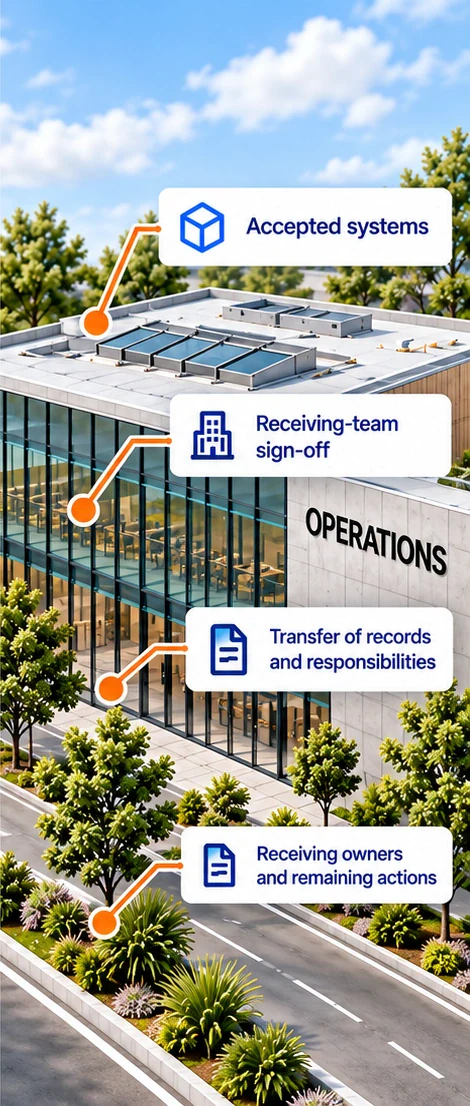
Bring acceptance, operability and handover into view together.
Useful records connect project activity to decisions. Five connected work areas retain their focus and dependencies, so the right information reaches the right people at the right time.

Each work area has a clear purpose, supported by the right information and dependent on decisions from the others.
Each work area has a different focus and depends on decisions from the others.

Define requirements and align the programme.
Scope, approvals and acceptance criteria. Depends on business case and stakeholder decisions.

Tender, evaluate and agree commercial commitments.
Supply strategy, terms and vendor readiness. Depends on approved requirements and funding.

Coordinate packages, resources and delivery actions.
Programme delivery, risk and change. Depends on procurement and site readiness.

Test, resolve actions and demonstrate acceptance.
Systems integration and operating documents. Depends on completed work and acceptance evidence.

Transfer records and responsibilities into operation.
Instructions, training and open actions. Depends on accepted systems and receiving-team sign-off.
Project information takes many forms. When it’s structured and connected, it enables clear oversight and accountability across the five work areas. Contractor compliance, site records, audits and corrective actions connect with workforce and risk responsibilities.
Useful project records connect delivery actions with decisions. Contractor compliance, site records, audits and corrective actions connect with workforce and risk responsibilities.
Project and implementation support can connect decisions, evidence and actions within an agreed scope.
SPPArC’s proposed role is project and implementation support within agreed scope. Engineering and construction responsibilities remain with the appointed parties.

SPPArC’s proposed role is project and implementation support within agreed scope. Engineering and construction responsibilities remain with the appointed parties.
Possible outputs, shaped to the agreed scope. These examples are illustrative, not promised deliverables.

Connects scope, actions, gates and owners.

Retains commercial and vendor evidence.

Connects utilisation and exceptions to decisions.

Defines readiness, acceptance and transfer.
Every project brings a different question into focus. Choose the area that best matches what you want to explore next, or browse related industries.





Share the project stage, the evidence available and the approval, package or handover question you need to resolve.

Helpful context, not prerequisites. Begin with the question you have.